
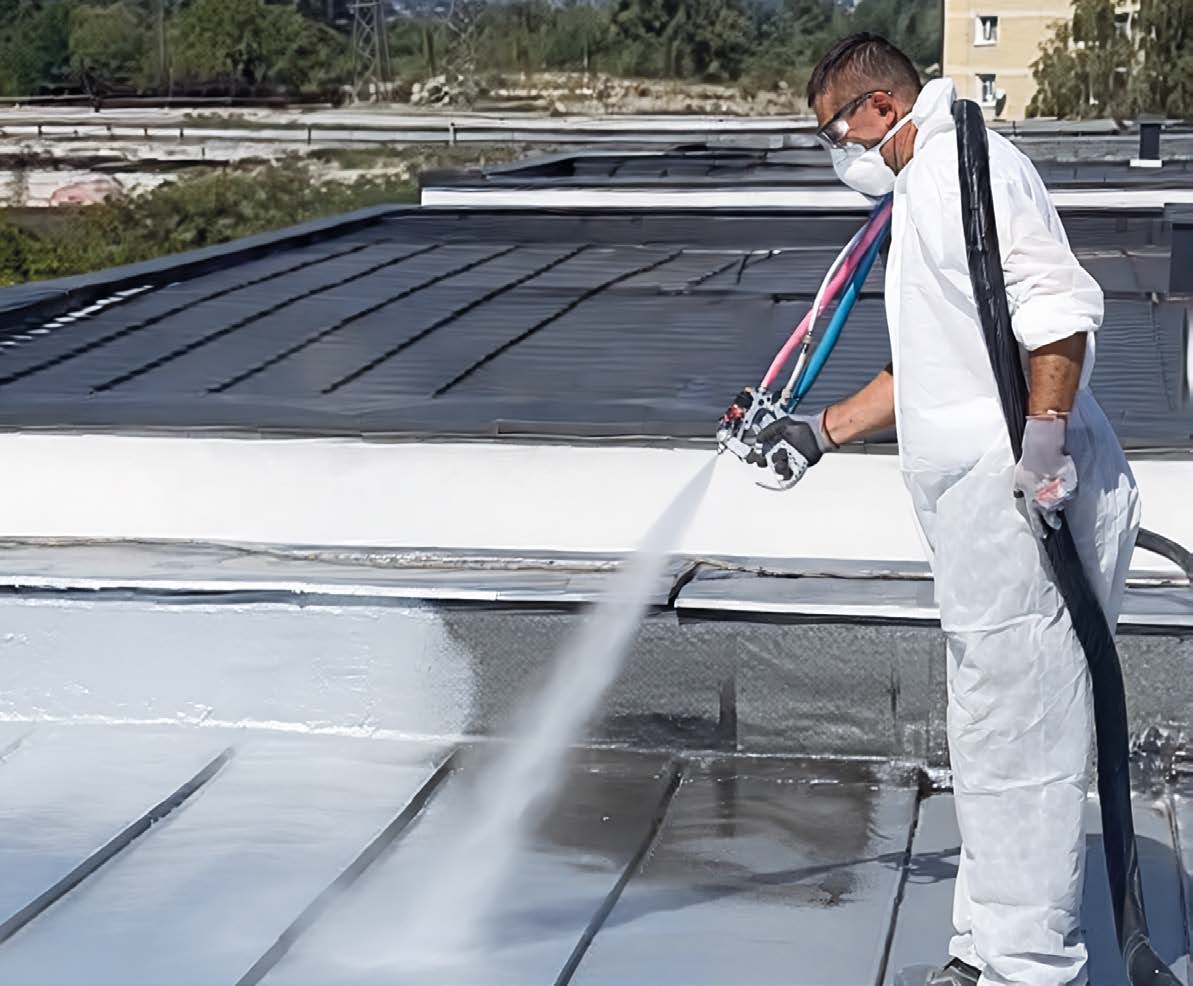
Thanks to their resistance, sustainability and fast curing properties, liquid membranes based on polyurea and polyurea-polyurethane hybrids are playing an increasingly important role in a wide range of applications, including waterproofing, flooring and anti-corrosion protection on concrete, steel and other substrates
Fast roof insulation through the effective combination of materials and spray technology
Polyurea coatings are spray-applied liquid membranes characterised by high resistance, waterproofing performance and very fast curing times.
These coatings are applied by spraying the two components mixed directly inside the PU spray gun onto the surface, ensuring excellent protection against abrasion, impact loads, chemical agents and corrosion.
These membranes are used on roofs, flooring systems, bridges
and concrete and steel structures – particularly in the water and wastewater management sector – as well as on parking decks and underground garages.
The benefits are evident:
- Protection of the substrate from moisture
- Protection of steel from corrosion
- Thermal stability – reliable performance across a wide temperature range
- Mechanical strength – excellent resistance to abrasion and impact
- Seamless, fully bonded layer – monolithic, joint-free
- Very low emission values
- Solvent-free
- Extreme durability – retains waterproofing and protective properties under various environmental stresses
- Elastic and flexible – accommodates substrate movements without cracking or delamination
- Chemical resistance – withstands various chemicals, including acids and oils
Case study:
a challenging construction site in Sarajevo
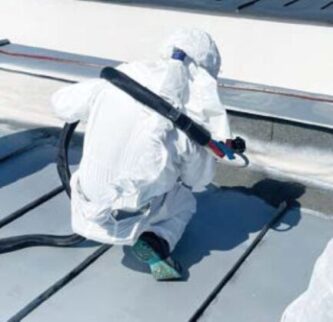
The project involves the waterproofing of several flat roofs on bungalows in Sarajevo, Bosnia. Local applicators were trained on the correct use of materials and the appropriate spray equipment. Using professional two-component high-pressure airless pumps, transfer pumps, heated hose assemblies, and a two-component mixing and atomizing spray gun, a coverage rate of 100–150 m² per hour is achieved. The team from b & m GmbH, headquartered in Oberteuringen, Germany, and the supplier of this type of professional spray equipment, travelled to Sarajevo to provide hands-on training under real on-site conditions. The spray unit was installed at ground level. Material supply (components A and B) is provided via two pneumatic transfer pumps drawing directly from 200-liter drums. The pumps feed the material to the pneumatically driven high-pressure pumps of the polyurea spray system.
Transfer pumps are pre-assembled on the drum lids. When a drum is empty, a new drum is opened, and the complete lid, including the transfer pump, is placed on top. This setup minimizes changeover time and prevents unnecessary ventilation of the material circuit.
THE WATERPROOFING OF FLAT ROOFS ON
BUNGALOWS IN SARAJEVO WAS SUCCESSFULLY
COMPLETED USING POLYUREA SPRAY SYSTEMS,
WITH ON-SITE TRAINING AND EQUIPMENT
PROVIDED BY B & M GMBH. THIS PROJECT
DEMONSTRATES THE EFFICIENCY AND
TECHNICAL PERFORMANCE OF MODERN
HIGH-PRESSURE SPRAY TECHNOLOGY.
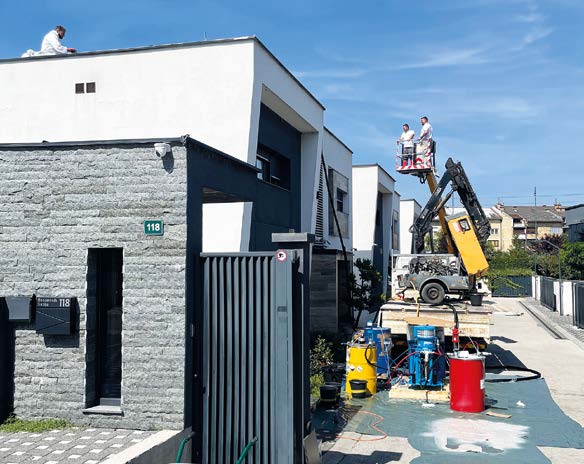
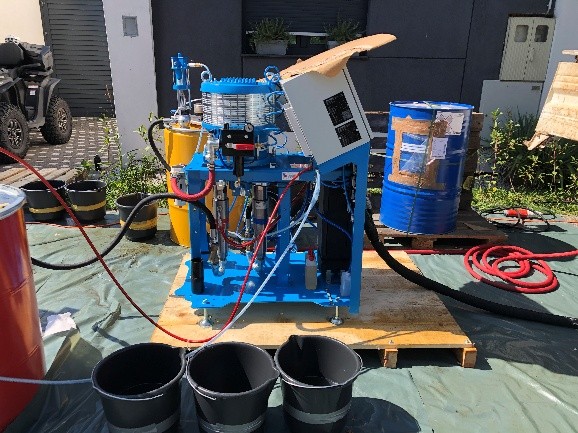
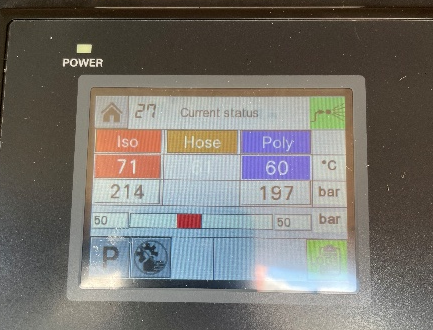
From left to right: Spray unit with dual pumps and integrated control panel; User-friendly control display; High-pressure application: the material is mixed inside the spray gun and atomized by airless high pressure, eliminating the need for additional atomizing air.
The high-pressure pumps pressurize components A and B, delivering them through separate hoses. From there, the material is conveyed via heated hose assemblies (up to 90 meters) to the spray gun for application. The extended hose length allows the material to be pumped vertically across several floors, while the spray equipment remains safely positioned at ground level. At the application area, the operator easily sprays the polyurea using the heated hose assembly and spray gun. This setup optimizes space requirements and significantly reduces time and logistical effort on site. Components A and B are delivered through separate heated hoses to a dedicated two-component spray gun equipped with an internal mixing chamber. Inside the gun, the components mix and discharge at high pressure through the spray nozzle. The mixed material is then applied to the surface in a fine, atomized spray pattern. Since the reaction time after exiting the spray gun is limited to only a few seconds, the applied coating is ready for subsequent layers or overcoating within minutes.
Electronic control and operating parameters
A key feature of the two-component spray system is its intelligent electronic control unit, equipped with a user-friendly display that provides all relevant operating parameters. The system monitors and displays critical data such as flow rate, material temperature, and mixing ratio tolerances. In the event of a malfunction, the system automatically issues a warning signal. The recommended
ambient air temperature for polyurea application ranges from 5 °C to 40 °C. Relative humidity levels of up to 85% are permissible, making the material suitable even for use in tropical climates. As an alternative to polyurea, PU foam insulation materials can also be processed using the same equipment. However, this technology is not a do-it-yourself solution. Proper training is essential.
Operators must be instructed by the equipment supplier on
correct handling, commissioning, shutdown procedures, and
thorough cleaning of all system components.
Proper training and safety
For appropriate material selection and correct application procedures, additional training provided by the material supplier is strongly recommended. Ideally, both the material and equipment suppliers should be present during the initial on-site training session to ensure optimal system setup and user qualification. Last but not least, the use of appropriate personal protective equipment (PPE) is mandatory.
The roofing project in Sarajevo was successfully completed within a remarkably short timeframe. All stakeholders expressed great satisfaction with both the technical results achieved and the longterm value of this forward-looking investment.
A KEY FEATURE OF THE
TWO-COMPONENT SPRAY SYSTEM
IS ITS INTELLIGENT ELECTRONIC CONTROL
UNIT, EQUIPPED WITH A USER-FRIENDLY
DISPLAY THAT PROVIDES ALL RELEVANT
OPERATING PARAMETERS.

